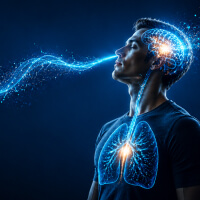

Description
Holotropic-Inspired Breathing is a short, energizing breathing practice that uses active, rhythmic inhales and exhales to help you feel more awake, focused, and mentally engaged. It is designed for moments of tiredness, low energy, or reduced concentration and is best practiced in the morning or during the day.
This is a brief, gentler exercise inspired by active breathwork. It is not traditional Holotropic Breathwork®. Extended breathwork sessions may last 60 minutes or longer, while an official Holotropic Breathwork® session typically lasts approximately 2.5–3 hours and is conducted with a trained facilitator or sitter. The Ultiself version lasts only 1–5 minutes, does not aim to produce an altered state of consciousness, and should remain comfortable throughout.

Time Commitment
1–5 minutes

Suggested Frequency
Once daily or as needed
Time of Day
Morning or daytime

How to Do It
Sit comfortably with your back supported and your feet resting on the floor. Relax your shoulders and begin breathing more actively than usual while keeping every breath controlled and comfortable.
Follow this pattern:
Inhale — 2 seconds
Take an active but comfortable breath in through your nose.
Take an active but comfortable breath in through your nose.
Exhale — 2 seconds
Actively breathe out through your mouth without forcing the air.
Actively breathe out through your mouth without forcing the air.
Continue in a steady rhythm without holding your breath:
1 minute — 15 cycles
3 minutes — 45 cycles
5 minutes — 75 cycles
The breathing should feel energizing, but it should never become extremely fast, forceful, or uncomfortable. Stop immediately if you feel dizzy, faint, numb, panicked, or short of breath.
1 minute — 15 cycles
3 minutes — 45 cycles
5 minutes — 75 cycles
The breathing should feel energizing, but it should never become extremely fast, forceful, or uncomfortable. Stop immediately if you feel dizzy, faint, numb, panicked, or short of breath.

Required Equipment
No equipment is required. Practice while seated in a safe, quiet place. Optional sound or haptic cues can help you maintain the two-second inhale and two-second exhale rhythm.

Benefits
This short active-breathing practice may help increase subjective alertness, direct attention to the present moment, and provide a temporary sense of energy or mental activation. Following a clear breathing rhythm may also help interrupt feelings of sluggishness and create a deliberate transition into work, study, or another daytime activity.
Research into high-ventilation and holotropic-style breathwork is still limited. Existing studies do not establish that short active breathing reliably improves energy, concentration, or mental health. The practice should therefore be presented as an optional well-being exercise rather than a treatment or a guaranteed method of increasing energy.
Why it works
Active breathing requires deliberate physical and mental engagement. Paying close attention to a steady rhythm may temporarily increase alertness and shift attention away from fatigue or passive thought patterns.
However, breathing more deeply or quickly than the body requires can reduce carbon dioxide levels. This may produce sensations such as lightheadedness, tingling, warmth, or increased activation. These sensations are not evidence of additional oxygen reaching the brain or of toxins leaving the body.
The shortened Ultiself exercise uses a controlled four-second cycle and limits the session to 1–5 minutes. It does not include the extended duration, evocative music, altered-state objective, emotional processing, facilitator support, or integration components associated with traditional Holotropic Breathwork®.

Possible Side Effects
Active breathing can cause dizziness, lightheadedness, tingling or numbness around the mouth and hands, headache, blurred vision, muscle tightness, chest discomfort, anxiety, panic, or a feeling of breathlessness. These effects may occur when breathing becomes too deep or too forceful.
If any discomfort occurs, stop immediately and return to normal breathing. Remain seated until you feel completely steady. Do not try to push through dizziness or complete the selected duration.
Do not practice while standing, driving, bathing, swimming, operating machinery, exercising, or in any situation where dizziness or reduced attention could cause injury.
Avoid this practice unless approved by a healthcare professional if you are pregnant or have cardiovascular disease, uncontrolled high blood pressure, a history of stroke, epilepsy or seizures, glaucoma or retinal problems, severe asthma or another significant respiratory condition, recent surgery or injury, osteoporosis, or a condition associated with fainting.
People with panic disorder, psychosis, severe post-traumatic symptoms, or other serious mental health conditions should consult a qualified healthcare professional before trying active breathwork. This exercise is not a substitute for medical or mental health treatment.

Tips
- Practice in the morning or during the day rather than before sleep.
- Always perform the exercise while seated.
- Keep the breathing active but comfortable.
- Do not take the deepest breath possible on every cycle.
- Avoid forcefully emptying your lungs.
- Keep your face, jaw, neck, and shoulders relaxed.
- Begin with the one-minute session, especially if you are new to active breathwork.
- Follow the animation instead of trying to breathe faster.
- Stop immediately if you experience dizziness, numbness, visual changes, chest discomfort, panic, or unusual muscle tension.
- Return to normal breathing after the final cycle and remain seated for several seconds before standing.
- Do not interpret tingling or dizziness as a sign that the exercise is working better.
- Use this practice for daytime activation, not as a relaxation exercise before sleep.
Supporting Studies and Articles
Upgrade Yourself with our Breakthrough App
Get UltiselfMore Habits




Rate Habit
Holotropic-Inspired Breathing