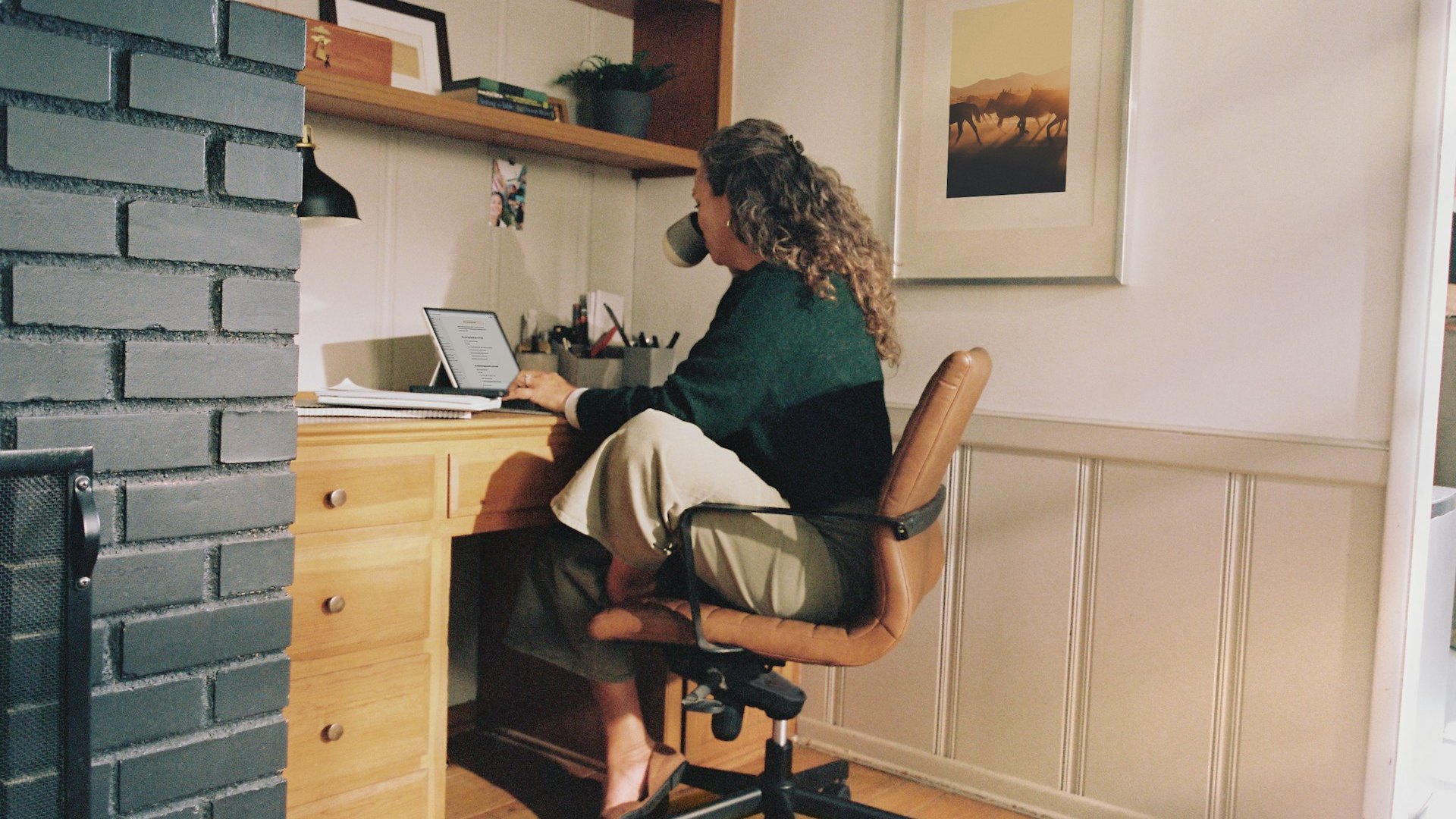
Deep work is focused, uninterrupted work on a cognitively demanding task, such as writing, coding, analysis or studying, done without email, chat or phone distractions. The term comes from computer scientist Cal Newport's 2016 book Deep Work. To practice it, schedule blocks of one to four hours, remove distractions before you start and decide in advance exactly what you will work on.
What is deep work?
Deep work is professional activity done in a state of distraction-free concentration that pushes your thinking to its limits. Cal Newport, who coined the term, describes it as work that creates new value, improves your skills and is hard for others to copy [1]. Examples include writing a report, solving a hard technical problem, designing a product or learning a complex subject.
Deep work does not require a special job or a quiet office. It requires a block of time, a clearly defined task and protection from interruptions. Many people already do deep work occasionally, for example when a deadline forces them to switch everything off. Practicing it deliberately simply makes those productive hours more frequent and less dependent on pressure. It is a skill that improves with training, much like physical fitness.
Deep work vs shallow work: examples
Shallow work is the opposite of deep work: tasks that are logistical, easy to do while distracted and easy for someone else to replicate. Answering routine emails, scheduling meetings, filling in forms and most messaging fall into this group. Shallow work is often necessary, but it rarely creates much new value on its own.
The goal is not to eliminate shallow work but to keep it from filling every hour. Many knowledge workers spend most of their day on shallow tasks simply because they arrive constantly and feel urgent. Separating the two kinds of work, and giving deep work protected time, is the core idea behind the approach.
| Aspect | Deep work | Shallow work |
|---|---|---|
| What it is | Demanding tasks that need full concentration | Routine tasks that can be done while distracted |
| Examples | Writing, coding, analysis, design, studying, strategy | Email, scheduling, admin, routine meetings, messaging |
| Value | Creates new value and builds skills | Keeps things running but is easy to replicate |
| Best time | Your most alert hours, in long blocks | Lower-energy times, batched together |
| Effect of interruptions | Large, quality drops quickly | Small, easy to resume |
Most jobs need both kinds of work. The practical question is how many hours each week go to deep work and whether those hours fall at the times when you think most clearly. Tracking this for a week often reveals that deep work happens far less than people assume.
Why deep work matters
Deep work matters because hard problems need sustained attention. Every time you switch to email or a message, part of your attention stays behind. Organizational researcher Sophie Leroy called this attention residue and found that people who switched away from an unfinished task performed worse on the next one [2]. A day full of small switches leaves little room for clear, high-quality thinking.
Interruptions also have hidden costs. In a study by Gloria Mark and colleagues, people who were interrupted completed tasks just as quickly but reported more stress, frustration and time pressure [3]. Long focused blocks reduce that strain. Research on expert performance also suggests that even highly skilled people can sustain intense, deliberate practice for only a few hours a day [4], which is why a few deep hours often produce more than a full day of fragmented work.
- Better quality on complex tasks.
- Faster progress on important projects.
- Quicker learning of difficult skills.
- Less stress from constant switching.
- A clearer sense of accomplishment at the end of the day.
4 ways to schedule deep work
Newport describes four ways to fit deep work into a schedule, each suited to different jobs and lives [1]. You do not need to choose one forever. Many people start with the rhythmic style because it is the easiest to fit around ordinary work, then adjust as they learn what works for them.
The right style depends on how much control you have over your calendar and how much collaboration your job requires. Someone with many meetings will need a different approach from a writer who works alone.
Monastic
The monastic style removes almost all shallow work and distractions for long periods. A researcher might avoid email entirely and focus on one major project for months. It produces a lot of deep work but suits only a few people, usually those whose value comes almost entirely from one type of output. Most people with teams, clients or managers cannot disappear for months, so they borrow parts of this style rather than adopting it fully.
Bimodal
The bimodal style splits time into clear deep and shallow periods, such as several deep days each week or a few deep weeks each quarter. During deep periods you work as if monastic, and the rest of the time you are fully available. It suits people who can set aside whole days, such as academics or consultants between projects. Even one deep day a week, with meetings moved to other days, can make a noticeable difference for many office workers.
Rhythmic
The rhythmic style schedules deep work at the same time every day, for example 8 to 10 a.m. before meetings begin. The regular rhythm turns deep work into a habit and removes the daily decision of when to focus. This is the most practical style for people with standard jobs and a fair number of meetings. Protecting the same two hours every morning is often easier to negotiate with colleagues than irregular blocks.
Journalistic
The journalistic style fits deep work into whatever free time appears, switching into focus quickly when a gap opens. It is flexible but hard for beginners, because shifting into deep concentration on short notice takes practice. It works best for people who already have strong focus habits. Newport himself describes it as an approach for experienced practitioners rather than a starting point.
How to do deep work step by step
Deep work is easier when you prepare before each session rather than relying on willpower once it starts. Clear rules about when, where and on what you will focus remove many of the small decisions that usually lead to distraction.
Start with shorter blocks of 60 to 90 minutes if long sessions feel difficult, and treat each finished block as a win. Focus improves with practice, and many people can gradually extend to two to four hours of deep work a day.
- Choose one specific task and define what you want to finish by the end of the session.
- Block the time in your calendar as you would a meeting.
- Close email and chat, turn off notifications and put your phone in another room.
- Gather everything you need before you start, so you do not leave to look for it.
- Work until the block ends, writing down unrelated thoughts on paper instead of acting on them.
- Take a real break afterward, ideally away from screens.
- At the end of the day, note what you achieved and plan tomorrow's deep work block.
Rituals that help you focus
Simple rituals make it easier to switch into deep work. Working in the same place, using the same playlist or starting with the same short routine, such as making tea and opening only the document you need, tells your brain it is time to concentrate. Over weeks, the ritual itself becomes a cue that reduces the effort needed to begin. Telling colleagues about your focus hours, or setting a status message, adds a social signal that helps protect the time.
A shutdown ritual at the end of the workday helps too. Reviewing your tasks, writing down where you stopped and planning tomorrow's first deep block lets you leave work mentally, which supports rest and makes the next morning's start faster.
Deep work examples for different jobs
Deep work looks different depending on the job, but the principle stays the same: protected time for the most demanding, valuable tasks. Seeing concrete examples makes it easier to identify your own deep work and plan time for it.
If you are unsure what counts as deep work in your role, ask which tasks would most improve your results if you did them better, and which ones require your full attention. Those are usually the tasks that deserve your best hours.
In roles with many meetings, deep work may only fit into one or two blocks a week at first. That is still valuable. Protecting even a small amount of focused time consistently tends to produce better results than waiting for a perfectly clear week that never arrives.
- Software developer: designing a system, writing complex code or debugging a hard problem.
- Writer or marketer: drafting an article, building a campaign strategy or editing a long piece.
- Analyst: building a model, analyzing data or writing up findings.
- Manager: planning team goals, preparing a difficult decision or designing a process.
- Student: studying a difficult chapter, working on problem sets or writing an essay.
- Designer: creating new concepts or solving a complex user experience problem.
How to practice deep work step by step
Deep work becomes sustainable when it is a regular part of your week rather than an occasional effort. Each step in this plan connects to a habit, so you can build the routines that protect focus and track how much deep work you actually do.
Start with one daily block at the same time, then add the habits that reduce distractions. Our guides on [how to improve focus](https://ultiself.com/blog/how-to-improve-focus) and [how to reduce screen time](https://ultiself.com/blog/how-to-reduce-screen-time) offer more ways to protect your attention, and [how to prioritize tasks](https://ultiself.com/blog/how-to-prioritize-tasks) helps you choose what deserves those hours.
| Step | Why it may help | Habit to practice |
|---|---|---|
| Schedule a daily deep work block | Makes focus a regular habit | [Timeboxing](https://ultiself.com/habits/timeboxing) |
| Work in focused timed sessions | Builds concentration step by step | [Focus timer](https://ultiself.com/habits/pomodoro-technique) |
| Remove distractions before starting | Reduces attention residue from switching [2] | [Mindful work](https://ultiself.com/habits/mindful-work) |
| Batch email and messages | Keeps shallow work in its own time | [Batch your tasks](https://ultiself.com/habits/batch-your-tasks) |
| Plan tomorrow's deep work | Starts the day with a clear focus | [Plan next day's tasks ahead](https://ultiself.com/habits/plan-next-days-tasks-ahead) |
| Train attention outside work | Makes it easier to sustain focus | [Focus training](https://ultiself.com/habits/focus-training) |
With Ultiself, you can track your deep work sessions and related habits, which makes it easy to see how many focused hours you get each week and which routines help most. Even a simple weekly count of deep work blocks is a powerful motivator once you see it grow.
Common questions
What is deep work?
Deep work is focused, uninterrupted work on a demanding task, such as writing, coding or analysis, done without distractions. The term was coined by Cal Newport in his 2016 book Deep Work.
What is the difference between deep work and shallow work?
Deep work needs full concentration and creates new value. Shallow work is routine and easy to do while distracted, such as email, scheduling and admin tasks.
How many hours of deep work can you do a day?
Many people can sustain about one to four hours of deep work a day. Beginners often start with 60 to 90 minutes and build up with practice.
How do I start doing deep work?
Choose one specific task, block time in your calendar, turn off notifications, put your phone in another room and work until the block ends. Starting at the same time each day helps.
What are examples of deep work?
Writing a report, coding a complex feature, analyzing data, designing a product, planning a strategy and studying a difficult subject are common examples.
Sources
- Newport C. Deep Work: Rules for Focused Success in a Distracted World. Grand Central Publishing, 2016.
- Leroy S. Why is it so hard to do my work? The challenge of attention residue when switching between work tasks. Organizational Behavior and Human Decision Processes, 2009.
- Mark G, Gudith D, Klocke U. The cost of interrupted work: more speed and stress. Proceedings of the SIGCHI Conference on Human Factors in Computing Systems, 2008.
- Ericsson KA, Krampe RT, Tesch-Römer C. The role of deliberate practice in the acquisition of expert performance. Psychological Review, 1993.