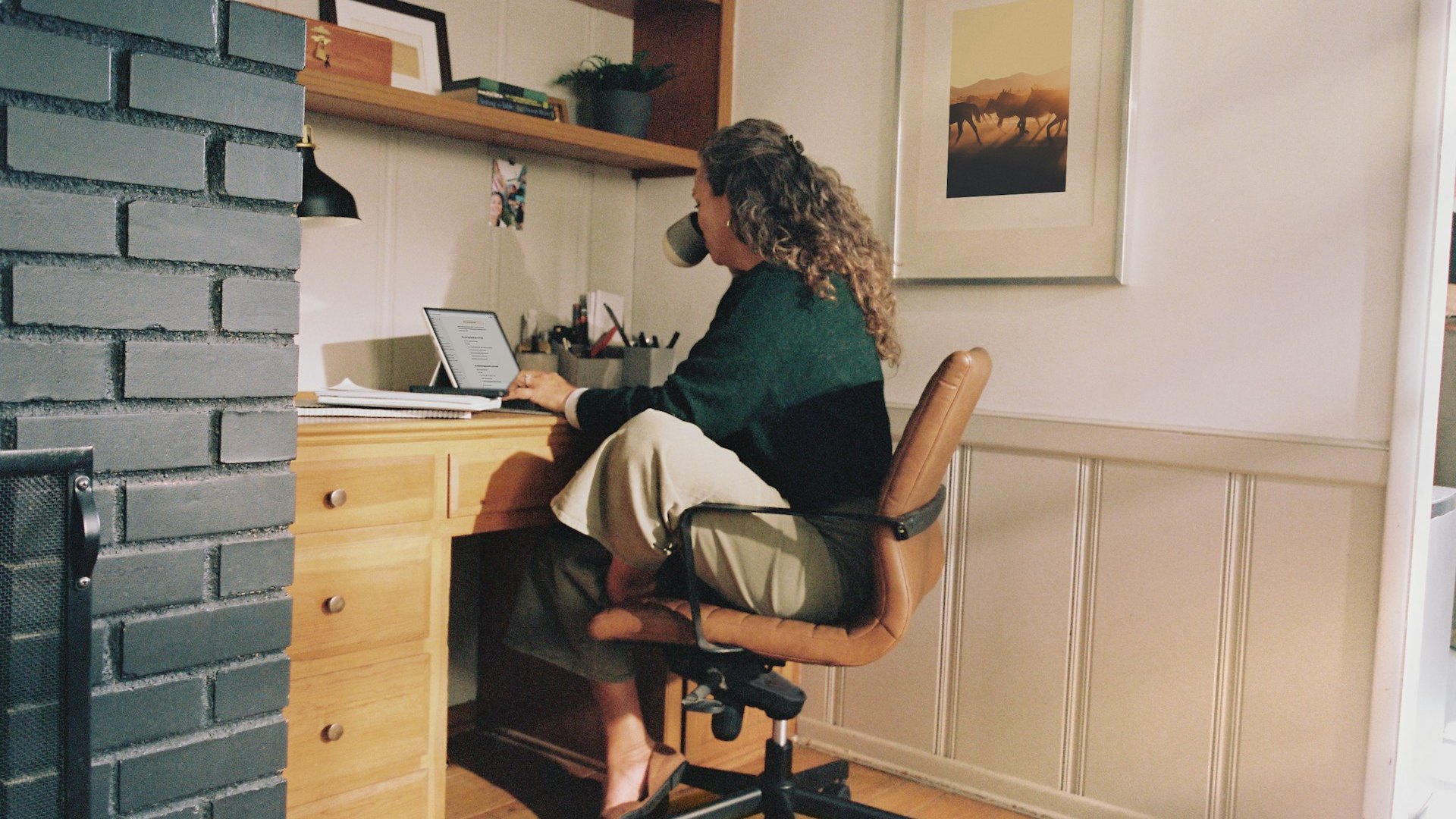
To focus better, work on one task at a time, remove the distractions you can control, such as phone notifications, and use short timed work blocks with real breaks between them. Over the longer term, sleep, regular movement and time outdoors support attention. Research suggests our minds wander almost half of our waking hours [1], so losing focus is normal and can be trained.
Why is it so hard to focus?
Focus is the ability to direct attention to one thing while ignoring others, and it has limits. In a large study that used a phone app to sample people's thoughts during the day, minds were wandering about 47% of the time, and people reported feeling less happy while their minds wandered [1]. Losing focus is part of how the brain works, not a personal failure.
Modern work makes this harder. Researcher Gloria Mark and colleagues have tracked how long people stay on one screen before switching, and the average has fallen from about two and a half minutes in the early 2000s to under a minute in recent studies [2]. Each switch costs time and mental energy, especially when the task you return to is complex.
What breaks concentration most
Some distractions come from outside, such as notifications, messages, noise and colleagues. Others come from inside, such as worries, hunger, tiredness or a task that feels unclear or unpleasant. Both kinds matter, and knowing which one is affecting you makes it easier to choose the right fix.
Unfinished tasks also pull at attention. Management researcher Sophie Leroy described this as attention residue: when you switch from one task to another, part of your mind stays with the first task, and performance on the second one suffers [3]. Closing a task properly, or writing down where you stopped, can reduce this effect.
- Notifications and messages that interrupt deep work.
- Switching between several tasks or browser tabs.
- Tiredness, hunger and long stretches without a break.
- Vague tasks without a clear first step.
How to focus right now: quick techniques
When you need to concentrate in the next hour, a few practical changes make a noticeable difference. Most of them work by reducing the number of choices and interruptions your brain has to handle, so more attention is left for the task itself.
These techniques are simple, but they work best together. Start with the first two, which tackle the most common causes of lost focus, then add the others as you need them.
Single-task and clear the next step
Choose one task and write down the very next action, such as drafting the first paragraph or answering one specific question. A clear next step makes it easier to start and keeps you from drifting toward easier tasks. Close the tabs and apps you do not need for that task before you begin.
People often believe they are good at multitasking, but research points the other way. In a well-known study at Stanford, people who multitasked heavily with media were worse at filtering out irrelevant information and slower at switching between tasks than light multitaskers [4]. Doing one thing at a time is usually faster overall.
Put your phone out of reach
Turning notifications off for an hour removes the most frequent interruptions. Placing the phone in another room or a drawer goes a step further, because seeing it can be a cue to check it. One study found that people performed worse on attention tasks when their phone was on the desk than when it was in another room [5], although later studies have found smaller or mixed effects.
Even if the evidence on phone presence is still debated, the practical advice is simple and costs nothing. Keeping the phone out of sight removes the temptation and the habit of checking it, which is often enough to protect a work block. The [Digital cleanse](https://ultiself.com/habits/digital-cleanse) habit helps make this a regular practice.
Work in timed blocks with breaks
Working in short, timed blocks gives your attention a clear start and finish. The Pomodoro technique, for example, uses 25 minutes of focused work followed by a 5-minute break. Other people prefer 45 or 50 minutes. The exact length matters less than committing to one task until the timer ends.
Breaks are part of the method, not a reward. A review of studies on micro-breaks found that short breaks during work were linked with more energy and less fatigue [6]. Use breaks to stand up, stretch, drink water or look out of a window, rather than switching to your phone. The [Focus timer](https://ultiself.com/habits/pomodoro-technique) and [Regular breaks](https://ultiself.com/habits/regular-breaks) habits support this rhythm.
What is the best focus technique?
There is no single best focus technique for everyone, because people and tasks differ. The most effective approach for most people combines single-tasking, a distraction-free setup and timed work blocks with real breaks. The table compares common techniques so you can choose a starting point that fits your work.
Try one technique for a week before judging it. Focus improves with practice, and a method that feels awkward on the first day often becomes natural once it is part of your routine.
| Technique | How it works | Best for |
|---|---|---|
| Pomodoro | 25 minutes of work, 5-minute break, longer break after four rounds | Tasks you tend to avoid or put off |
| Timeboxing | Assign a fixed time slot to each task in your calendar | Busy days with many small tasks |
| Single-tasking | One task and one window open until it is done | Writing, analysis and complex problems |
| Deep work blocks | 60 to 90 minutes of uninterrupted work, usually in the morning | Demanding projects that need full attention |
If you work in an open office or at home with family, combine any of these with noise-canceling headphones or [Focus sounds](https://ultiself.com/habits/focus-sounds) to reduce background distractions. Steady, low-level sound can mask sudden noises, which are often more distracting than a constant background hum.
How to improve focus long term
Quick techniques help in the moment, but lasting focus depends on how you live. Sleep, physical activity, time outdoors and regular breaks all support the brain systems involved in attention. Small improvements in these areas often make concentration easier without extra effort during the day.
Sleep and movement
Sleep loss has a clear effect on attention. A meta-analysis of sleep deprivation studies found that attention and vigilance were among the abilities most affected by lack of sleep [7]. Regular sleep and wake times are one of the most reliable ways to protect concentration. Our guide on [how to fix your sleep schedule](https://ultiself.com/blog/how-to-fix-your-sleep-schedule) explains how to reset a routine that has drifted.
Exercise helps too. A meta-analysis found that a single session of exercise had a small positive effect on cognitive performance, including tasks that rely on attention, in the period after the workout [8]. You do not need intense training to benefit. A brisk walk before a demanding task is a simple place to start.
Time outdoors and mindfulness
Spending time in nature may help restore attention after mental effort. In a study by Marc Berman and colleagues, people performed better on a demanding attention test after a walk in a park than after a walk along busy city streets [9]. Even short breaks outdoors can be a useful reset during a long day.
Mindfulness practice trains the skill of noticing when attention drifts and bringing it back. Studies on mindfulness and attention show mixed but promising results, and many people find a few minutes of daily practice helpful. The [Walk outside](https://ultiself.com/habits/walk-outside) and [Meditation](https://ultiself.com/habits/meditation) habits make these practices part of your week.
How to stay focused at work or when studying
Work and study bring their own challenges, from meetings and messages to long reading sessions. Planning when you focus is as important as how you focus. Most people have a few hours a day when their energy is highest, and protecting those hours for demanding tasks is one of the most effective changes you can make.
At work, block focus time in your calendar, set your chat status to busy and batch messages and email into two or three set times. When studying, break material into short sessions with a clear goal, such as summarizing one section, and test yourself rather than rereading. Our guide on [what deep work is](https://ultiself.com/blog/what-is-deep-work) covers how to plan longer focus sessions.
Remote and hybrid work add a different challenge, because home offers its own distractions, from chores to family. A fixed start time, a dedicated place to work and a short shutdown ritual at the end of the day help separate focused work from the rest of home life. Our guide on [how to stop procrastinating](https://ultiself.com/blog/how-to-stop-procrastinating) covers what to do when starting is the hardest part.
- Schedule demanding tasks for your highest-energy hours.
- Check email and messages at set times instead of all day.
- Plan tomorrow's top three tasks before you finish today.
- For study, set a goal for each session and test yourself.
Focus myths: multitasking and brain games
Two popular ideas about focus do not hold up well. The first is that multitasking saves time. In reality, switching between tasks adds small costs each time, and heavy multitaskers tend to be more easily distracted, as the Stanford study showed [4]. Doing tasks one after another is usually faster and leads to fewer mistakes.
The second myth is that brain-training games improve focus in daily life. A large review found that these games improve performance on the trained tasks, but there was little evidence that the benefits carried over to everyday attention or other skills [10]. Practicing focus on the work that matters to you is likely to be more useful.
How to improve focus step by step
Improving focus works best as a set of small daily habits rather than a single big change. Start with the steps that address your biggest distraction, then add the others over the next few weeks.
Each step is linked to a habit, so you can practice it regularly and see which changes actually help you concentrate. Notice how your focus feels after a week, rather than expecting results after one day.
| Step | Why it may help | Habit to practice |
|---|---|---|
| Plan your top three tasks the evening before | A clear next step reduces drifting | [Create 3 critical tasks for tomorrow](https://ultiself.com/habits/create-3-critical-tasks-for-tomorrow) |
| Work in timed blocks | Gives attention a clear start and finish | [Focus timer](https://ultiself.com/habits/pomodoro-technique) |
| Keep your phone out of sight | Removes the most common interruption | [Digital cleanse](https://ultiself.com/habits/digital-cleanse) |
| Take short breaks away from screens | Breaks were linked with less fatigue [6] | [Regular breaks](https://ultiself.com/habits/regular-breaks) |
| Walk outside during the day | Nature walks were linked with better attention [9] | [Walk outside](https://ultiself.com/habits/walk-outside) |
| Keep regular sleep times | Sleep loss strongly affects attention [7] | [Sleep hygiene routine](https://ultiself.com/habits/sleep-hygiene-routine) |
With Ultiself, you can track these focus habits day by day and see which ones you keep up, which makes it easier to notice what genuinely helps your concentration. After a few weeks, the pattern is usually clear: one or two habits make the biggest difference, and those are the ones worth protecting on busy days.
Common questions
How can I focus better?
Work on one task at a time, put your phone out of reach, and use timed work blocks with short breaks. Over time, regular sleep, exercise and time outdoors also support concentration.
What is the best focus technique?
There is no single best technique for everyone. Most people do well with single-tasking, a distraction-free setup and timed blocks such as the Pomodoro method, then adjust the block length to their work.
Why can't I focus?
Common reasons include notifications, switching between tasks, tiredness, hunger and unclear tasks. If concentration problems are persistent and affect daily life, it is worth talking to a doctor.
How long can a person focus?
It varies by person and task. Many people work well in blocks of 25 to 90 minutes with breaks in between, and the right length depends on how demanding the task is.
Do brain games improve focus?
Research suggests brain-training games improve performance on the games themselves, but there is little evidence that this carries over to focus in everyday life.
Sources
- Killingsworth MA, Gilbert DT. A wandering mind is an unhappy mind. Science, 2010.
- Mark G. Attention Span: A Groundbreaking Way to Restore Balance, Happiness and Productivity. Hanover Square Press, 2023.
- Leroy S. Why is it so hard to do my work? The challenge of attention residue when switching between work tasks. Organizational Behavior and Human Decision Processes, 2009.
- Ophir E, Nass C, Wagner AD. Cognitive control in media multitaskers. Proceedings of the National Academy of Sciences, 2009.
- Ward AF, Duke K, Gneezy A, Bos MW. Brain drain: the mere presence of one's own smartphone reduces available cognitive capacity. Journal of the Association for Consumer Research, 2017.
- Albulescu P, Macsinga I, Rusu A, et al. "Give me a break!" A systematic review and meta-analysis on the efficacy of micro-breaks for increasing well-being and performance. PLoS One, 2022.
- Lim J, Dinges DF. A meta-analysis of the impact of short-term sleep deprivation on cognitive variables. Psychological Bulletin, 2010.
- Chang YK, Labban JD, Gapin JI, Etnier JL. The effects of acute exercise on cognitive performance: a meta-analysis. Brain Research, 2012.
- Berman MG, Jonides J, Kaplan S. The cognitive benefits of interacting with nature. Psychological Science, 2008.
- Simons DJ, Boot WR, Charness N, et al. Do "brain-training" programs work? Psychological Science in the Public Interest, 2016.