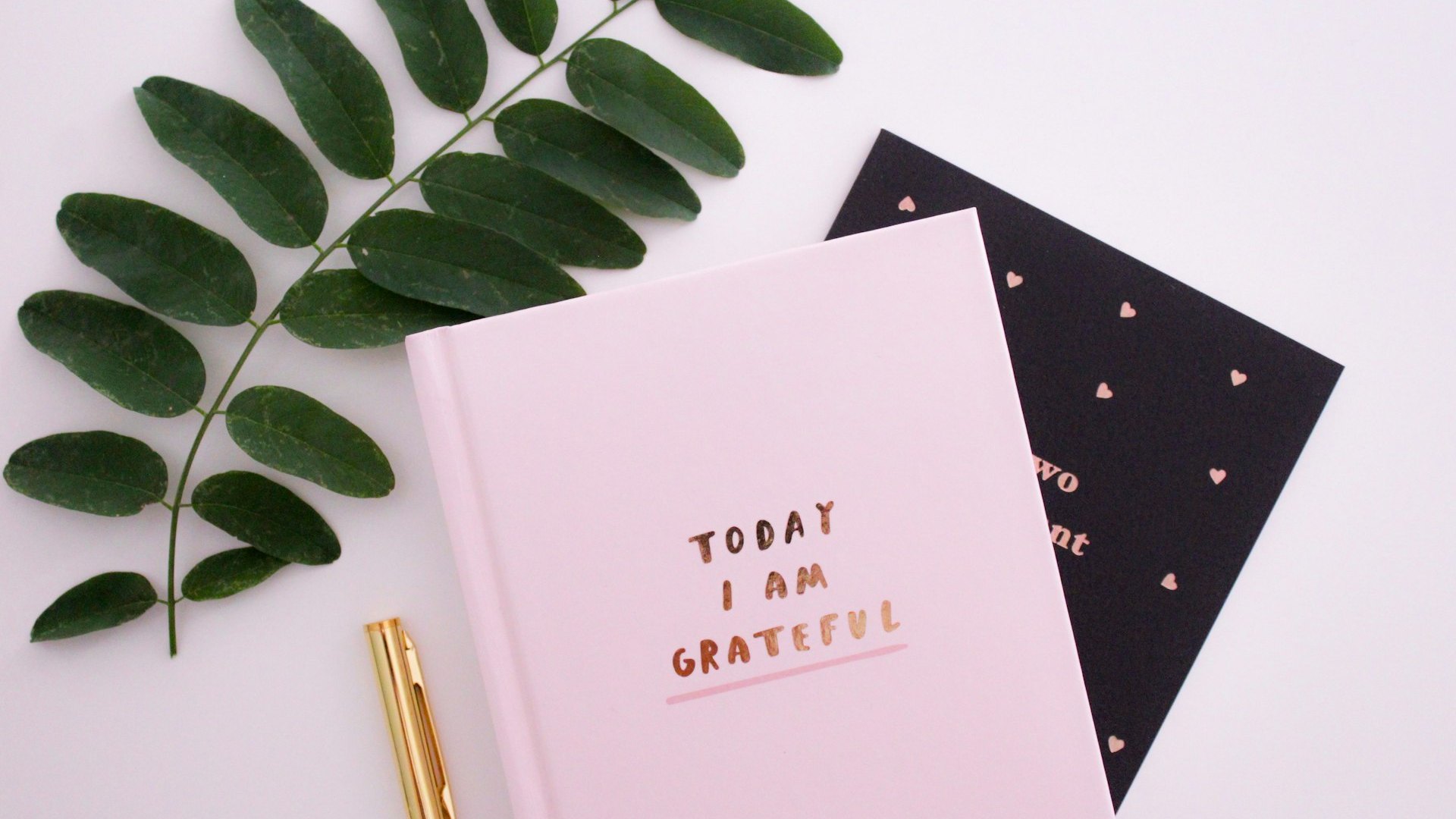
A gratitude journal is a notebook or app where you regularly write down things you are thankful for, from small daily moments to important people in your life. Gratitude journal prompts, such as "What made me smile today?" or "Who helped me this week?", make it easier to start and keep entries fresh. Research suggests that writing about gratitude a few times a week may modestly improve mood and life satisfaction.
What is a gratitude journal?
A gratitude journal is a simple practice of recording good things in your life. Entries can be short lists, a few sentences or longer reflections. The aim is to train your attention to notice what is going well, which can be easy to overlook when life is busy or stressful. Over time, many people find they start spotting good moments during the day, not just when they sit down to write.
Gratitude journaling differs from general journaling because it has a specific focus. Instead of writing about everything on your mind, you look for moments, people, experiences and qualities you appreciate. Many people combine it with other journaling, for example adding three gratitude points at the end of an evening entry. Our guide on [how to start journaling](https://ultiself.com/blog/how-to-start-journaling) covers other journaling styles.
Does gratitude journaling work?
Research on gratitude journaling is encouraging, with modest effects. In well-known studies by Robert Emmons and Michael McCullough, people who wrote about things they were grateful for each week reported feeling better about their lives and more optimistic than people who wrote about hassles or neutral events [1]. Martin Seligman and colleagues found that writing down three good things each day was linked with higher happiness for several months [2].
Larger reviews give a more cautious picture. A meta-analysis by Lilian Dickens found that gratitude interventions had small to moderate benefits for well-being and happiness compared with neutral activities [3]. Gratitude journaling is not a cure for low mood, but it is an easy, low-cost habit that many people find helpful.
- Small to moderate improvements in well-being in many studies.
- More optimism and life satisfaction in some trials.
- Benefits depend on regular, sincere practice.
- Not a replacement for professional help with persistent low mood.
How often should you write?
More is not always better. In a study by Sonja Lyubomirsky and colleagues, people who counted their blessings once a week reported greater benefits than those who did it three times a week, possibly because frequent repetition made the practice feel routine [4]. Many people find two to three times a week a good balance, while others enjoy a short daily entry. Choose what keeps the practice meaningful for you, and adjust if entries start to feel like a chore.
How to keep a gratitude journal
Starting a gratitude journal takes only a few minutes. Choose a notebook or app, pick a regular time, such as before bed or with morning coffee, and decide how many things you will write each time. Three to five items is a common starting point, and even one specific item is better than skipping the entry.
Specific entries tend to feel more meaningful than general ones. "I am grateful for my friend Anna, who called to check on me after a hard day" usually has more impact than "I am grateful for my friends." Writing about people often feels especially rewarding, and including why you are grateful helps you relive the moment.
Some people extend the practice by sharing their gratitude. Sending a short thank-you message to someone you wrote about turns a private note into a moment of connection. In Seligman's research, writing and delivering a gratitude letter produced a noticeable boost in happiness, although it faded after about a month [2].
- Choose a notebook or app you will use.
- Pick a regular time and place.
- Write three to five things each time.
- Be specific and include why you are grateful.
- Vary your entries to avoid repeating the same items.
- Use prompts when you feel stuck.
- Look back at old entries once a month.
50 gratitude journal prompts
Prompts help when your mind feels blank or your entries start to repeat. These 50 prompts are grouped into five themes, so you can choose based on your mood or focus for the day. Use one prompt per entry or combine a few.
There is no need to answer every part of a prompt. Let it guide your attention and write whatever comes to mind, even if it drifts away from the original question. The prompts for hard days are especially useful when gratitude feels out of reach.
Prompts about people
- Who made my day better today, and how?
- Who has helped me grow as a person?
- What is something a friend did that I never thanked them for?
- Which family member am I grateful for, and why?
- Who made me laugh recently?
- What is a kind thing a stranger did for me?
- Who do I trust completely?
- Which teacher or mentor shaped my life?
- What do I appreciate about my partner or closest friend?
- Who could I thank this week?
Prompts about everyday moments
- What made me smile today?
- What was the best part of my day?
- What small comfort did I enjoy today?
- What did I eat today that I really enjoyed?
- What sound, smell or view made me pause today?
- What went better than expected this week?
- What made my morning easier?
- What is something I often take for granted?
- What simple pleasure do I look forward to each day?
- What made me feel calm today?
Prompts about yourself
- What is a personal strength I am grateful for?
- What did my body help me do today?
- What challenge have I overcome that I am proud of?
- What skill have I learned that I value?
- What is something I like about my personality?
- How have I grown in the past year?
- What is a decision I am glad I made?
- What is one way I took care of myself today?
- What mistake taught me something important?
- What am I looking forward to becoming?
Prompts about places and things
- What place makes me feel at home?
- What is something in my home that I love?
- What part of nature am I grateful for?
- What book, song or film has meant a lot to me?
- What is a tool or technology that makes life easier?
- What season or weather do I enjoy most, and why?
- Where is my favorite place to relax?
- What object has a special memory attached to it?
- What is something I own that I use every day and value?
- What is a place I would love to visit again?
Prompts for hard days
- What is one small thing that went right today?
- Who can I lean on when things are hard?
- What has helped me get through difficult times before?
- What is something I can still enjoy, even today?
- What lesson might this difficult time hold?
- What strength am I using right now?
- What is one thing I am looking forward to?
- What made today a little easier?
- What would I tell a friend going through this?
- What am I grateful for that has not changed?
A simple gratitude journal template
A simple template keeps entries quick and consistent, especially on busy days. You can copy it into a notebook or use it as a structure in a notes app. Fill in each line with a sentence or two, and skip any line that does not fit that day.
The template mixes people, moments and yourself, which helps keep entries varied and prevents the practice from becoming a repeated list of the same items. It takes about five minutes to fill in.
| Section | What to write |
|---|---|
| Date | The day and, if you like, your mood |
| Three things I am grateful for today | Specific moments, people or experiences |
| Why one of them mattered | A sentence about why it felt meaningful |
| Someone I appreciate | A person and what they did |
| Something I did well | A strength or small achievement |
Once the template feels automatic, you can drop the structure and write freely, or keep it for days when you have little time. Some people alternate, using the template on weekdays and writing more freely at weekends.
Common gratitude journal mistakes
A common mistake is writing the same items every time, such as "my family, my home, my health." Repetition can make the practice feel automatic and less meaningful. Varying your focus, using prompts and adding details helps keep it fresh.
Another mistake is forcing gratitude on very difficult days or using it to dismiss real problems. Gratitude works best alongside honest acknowledgment of what is hard, not as a way to ignore it. Finally, many people start too ambitiously and give up. A few lines two or three times a week is more sustainable than long daily entries. Our guide on [how to be happy](https://ultiself.com/blog/how-to-be-happy) covers other research-based habits that support well-being.
- Repeating the same items every time.
- Writing vague lists without details.
- Using gratitude to dismiss real problems.
- Starting with entries that are too long.
- Giving up after missing a few days.
How to keep a gratitude journal step by step
Gratitude journaling becomes easier when it is a regular habit. Each step in this plan connects to a habit, so you can build the practice gradually and notice how it affects your mood over time.
Start with a short entry two or three times a week, then add the other steps once the habit feels natural. Linking the entry to an existing routine, such as after brushing your teeth, makes it easier to remember.
| Step | Why it may help | Habit to practice |
|---|---|---|
| Write three good things | Linked with higher happiness in studies [2] | [Gratitude journal](https://ultiself.com/habits/gratitude-journal) |
| Notice moments of gratitude during the day | Builds the habit of noticing good things | [Gratitude](https://ultiself.com/habits/gratitude) |
| Appreciate your own strengths | Balances self-criticism | [Gratitude on good traits](https://ultiself.com/habits/gratitude-on-good-traits-cbt) |
| Record small pleasures | Helps you notice everyday joys | [Micro pleasure journaling](https://ultiself.com/habits/micro-pleasure-journaling) |
| Reflect on your evening | A natural time for gratitude | [Evening journal reflection](https://ultiself.com/habits/evening-journal-reflection) |
With Ultiself, you can add gratitude journaling to your routine and track it alongside your mood, which makes it easier to see how the practice fits into your week. Looking back at entries on a difficult day is often a gentle reminder of what is still going well.
Common questions
What is a gratitude journal?
A gratitude journal is a notebook or app where you regularly write down things you are thankful for, such as people, moments, experiences and personal strengths.
What should I write in a gratitude journal?
Write three to five specific things you are grateful for and why. Prompts such as "What made me smile today?" or "Who helped me this week?" make it easier.
Does gratitude journaling really work?
Research suggests small to moderate benefits for well-being and mood. Results depend on regular, sincere practice, and it is not a replacement for professional help.
How often should I write in a gratitude journal?
Two to three times a week works well for many people. One study found weekly gratitude writing more beneficial than writing three times a week.
How do I keep a gratitude journal from getting repetitive?
Use prompts, vary your focus between people, moments and yourself, add details about why you are grateful and look back at old entries occasionally.
Sources
- Emmons RA, McCullough ME. Counting blessings versus burdens: an experimental investigation of gratitude and subjective well-being in daily life. Journal of Personality and Social Psychology, 2003.
- Seligman MEP, Steen TA, Park N, Peterson C. Positive psychology progress: empirical validation of interventions. American Psychologist, 2005.
- Dickens LR. Using gratitude to promote positive change: a series of meta-analyses investigating the effectiveness of gratitude interventions. Basic and Applied Social Psychology, 2017.
- Lyubomirsky S, Sheldon KM, Schkade D. Pursuing happiness: the architecture of sustainable change. Review of General Psychology, 2005.